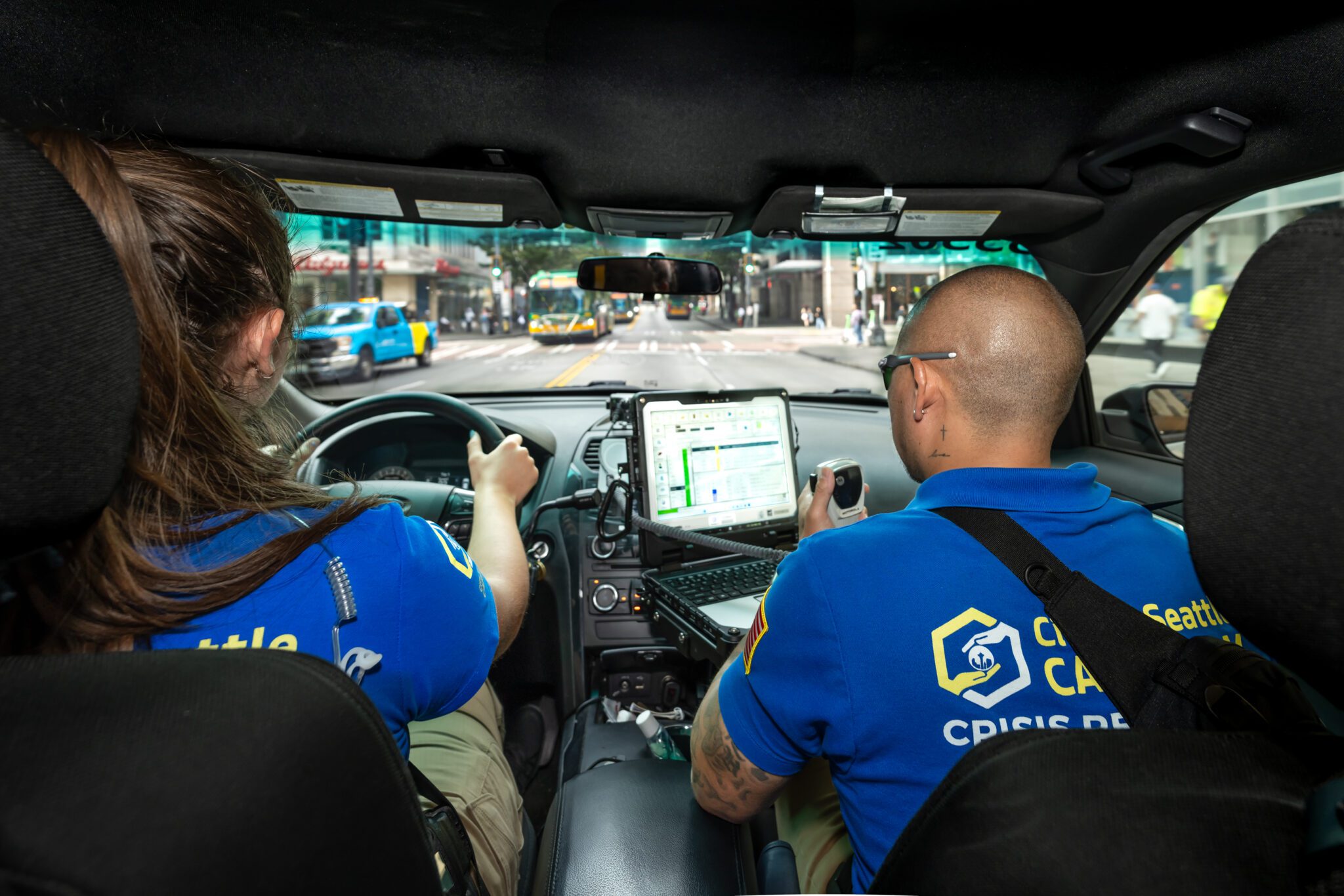
You may have seen them around the city—Community Crisis Responders, dressed in royal blue shirts and khaki pants. These crisis responders are the third branch of Seattle’s public safety system and work closely with local police agencies and Seattle Fire to address behavioral health calls, connect people with services, supplies and shelters, and reduce the likelihood of reoccurring 911 calls about individuals in crisis.
The CCR program first launched in October 2023, with six Community Crisis Responders (CCR) working downtown. Today, CARE’s 24 CCRs arrive at their offices—located in the Seattle Municipal Tower downtown, across from the North Precinct, at University of Washington Police Headquarters, in SODO at 3rd and Horton, and the Southwest Precinct, with an office soon to open at 12th Avenue and East Jefferson Street—grab radios and have a quick huddle about assignments. They discuss street contacts from previous days, what supplies may need replenishment, services that may be available to address emerging needs (like cooling centers) and begin responding to calls from 911 dispatchers.
The CCRs operate seven days a week from 12pm to 10pm, which data shows are the hours when calls about non-violent behavioral health crises and calls for wellness checks are most likely to come into 911. CCRs also carry basic items on hand to help in their contacts, like clothing, blankets, hygiene supplies, water, and food. They’re experienced in de-escalating and redirecting people in crisis, can assist in developing safety plans for individuals who are experiencing suicidal ideation, and have a deep working knowledge of local resources, shelters and services. Earlier this year, SPD officers called CCRs and requested their assistance providing food, water, and clothing to a group on Rainier Avenue. One man in the group told CCRs he needed somewhere he could put his dog while he received in-patient treatment. CCRs reached out to several services and ultimately connected the man with the Seattle Dog Homeless Program so he could continue with his treatment.
These kinds of interactions enable CCR to meet basic needs of people and potentially reduce the chances of future 911 calls. [Do we have any data that might back this up?] Since launch, CCRs have handled or assisted on over 2,800 calls. CCRs do not provide medical aid or do any law enforcement (and are unrelated to the city’s Unified Care Team), leaving those tasks to Seattle Fire and Police. Currently, CCRs are primarily dual-dispatched to calls with an SPD officer. Officers can then decide to clear themselves from a call and leave the response to CCRs. CARE hopes to expand the role of the CCRs in the future, allowing for a solo response which would free up police to respond to high-priority calls like life-threatening emergencies. CARE is working with the mayor’s office and Seattle Police Officers to expand CARE’s role in 911 response.
While 911 callers can’t yet specifically request CARE responders, there is information they can provide which may increase the odds of CCRs being sent to a call. For example, if you’re calling about someone you know, sharing that person’s information can allow officers to assess whether the call may be appropriate independent response by CCRs. Being clear about what you’re requesting is also helpful, so 911 operators know if you’re requesting police enforcement (like removing someone who is trespassing) or something that’s more clearly in a CCR’s area of expertise, such as a crisis response or wellness check.
As the Community Assisted Response and Engagement department, our community is at the heart of everything we do. We’re excited and honored to be able to serve Seattle as we continue to grow as the city’s third public safety branch. Our department remains focused on responding with compassion and ensuring every 911 call gets the right response at the right time.